

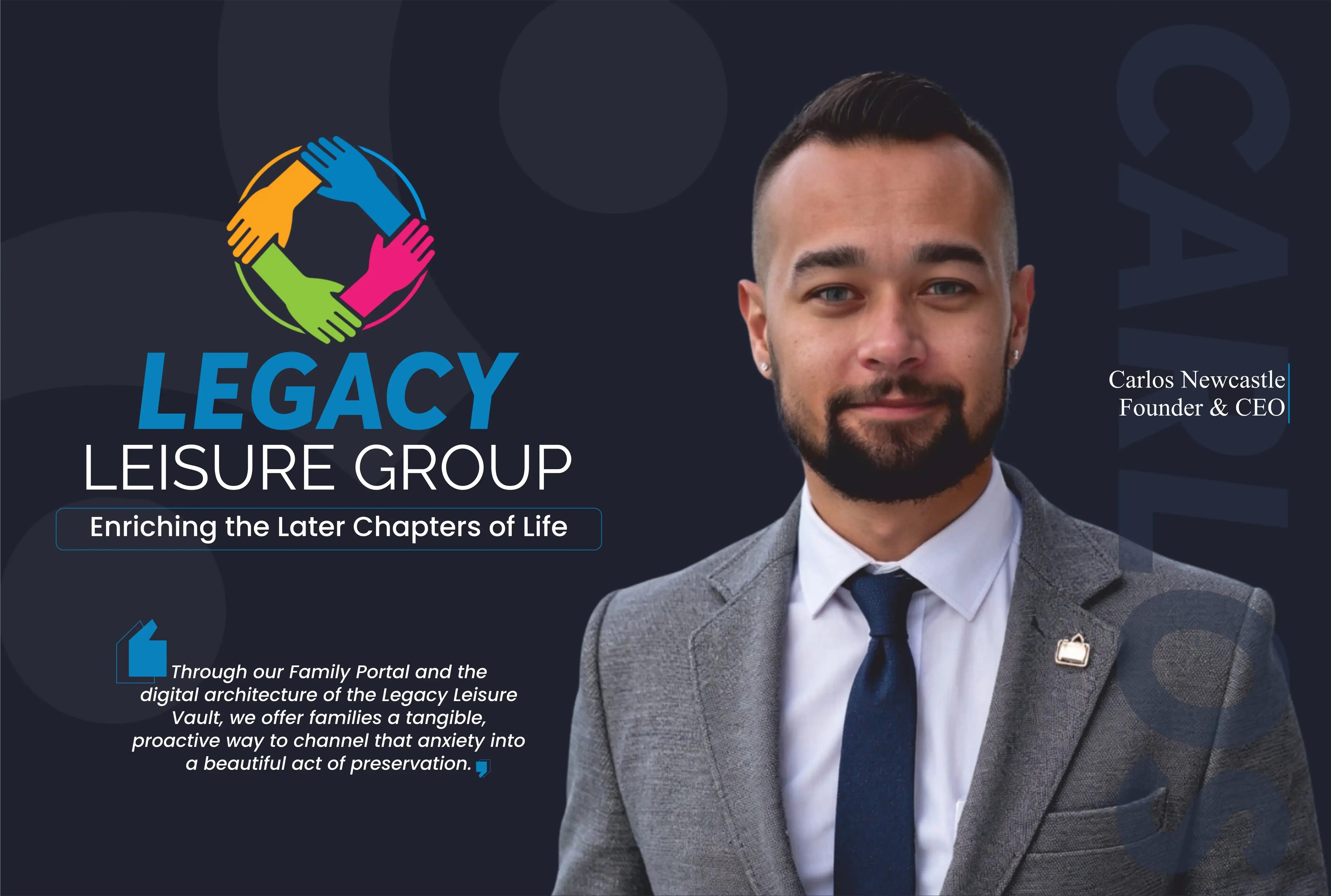
Legacy Leisure Group: Enriching the Later Chapters of Life
Growing
older should never mean becoming invisible. Yet for many seniors, the later
chapters of life can bring challenges that extend far beyond physical health.
Meaningful social connections may become harder to maintain. Familiar routines
can be disrupted by cognitive decline. Families struggle to preserve precious
memories while care communities work to balance growing operational demands
with the need for personalized attention. Amid these realities lies a
fundamental question: how can society ensure that older adults continue to
experience purpose, belonging, and meaningful engagement throughout every stage
of life?
Legacy
Leisure Group was founded to
answer that question. Combining innovative AgeTech solutions with deeply
personalized engagement strategies, the organization helps senior living
communities transform how they support residents and their families. Through
sensory-based programming, individualized engagement tools, family connectivity
platforms, legacy-preservation technologies, and purpose-driven initiatives,
Legacy Leisure Group creates experiences that celebrate identity, strengthen
relationships, and enhance quality of life.
A
Vision for More Personalized Senior Care
After
more than twelve years working across skilled nursing, assisted living, and
memory care environments, Carlos Newcastle developed a unique
understanding of the challenges facing senior living communities. Throughout
his career, he held a variety of roles, from facilitating therapeutic
activities directly with residents as a Happiness Coordinator to managing
admissions, operations, and family relations. These experiences provided him
with firsthand insight into the realities of senior care and the limitations of
traditional engagement models.
Time
and again, he observed that many communities relied on generalized activity
programs that often failed to accommodate residents with varying cognitive and
physical abilities. While these programs were designed with good intentions,
they frequently left some residents under-stimulated while others struggled to
participate meaningfully. At the same time, care teams were increasingly
occupied with documentation, compliance requirements, and operational
responsibilities, leaving limited opportunities for personalized engagement.
Recognizing
the absence of a system capable of connecting technology with meaningful,
person-centered care, Newcastle founded Legacy Leisure Group LLC in 2026. The
organization was created to bridge the gap between digital innovation and human
connection through an integrated AgeTech ecosystem that supports engagement,
family connectivity, memory care, and legacy preservation. Today, Legacy
Leisure Group is helping senior living communities rethink how they support
residents by placing individuality, dignity, and meaningful experiences at the
center of care.
Finding
Connection Beyond Cognitive Barriers
One
of the core philosophies behind Legacy Leisure Group is the belief that
engagement should be personalised rather than a one-size-fits-all approach. For
residents with cognitive decline, this philosophy takes on particular
importance as traditional methods of communication may not be as effective over
time.
To
address this challenge, the organization has created tailored Individualized
Engagement Kits tailored to each resident’s unique cognitive and physical
capabilities. The kits combine tactile, visual, and sensory components to evoke
emotional memory and encourage meaningful engagement.
Sensory-based
engagement reaches people through pathways that are often still available even
as cognitive abilities fade, unlike traditional recreational programming. Such
experiences can evoke memories, promote discussion, encourage social
interaction and offer moments of comfort and familiarity.
Legacy
Leisure Group helps communities create more personal experiences that support
emotional well-being and improve overall quality of life by integrating sensory
engagement in daily care routines.
Keeping
Personal Stories at the Center of Care
The
Legacy Leisure Group is based on the premise that a person’s identity should
never be defined by their age, illness or diagnosis. Every resident has a
lifetime of experiences, accomplishments, relationships and memories that
deserve recognition and celebration.
This
philosophy is reflected in the organization’s platform, which features detailed
profiles of residents that allow communities to learn about each person’s
unique history, preferences, interests and accomplishments. These profiles also
allow care teams to serve up activities and engagement opportunities that are
aligned to who residents are as people, not just their care needs.
This
personalized approach makes even the everyday programming meaningful
experiences. Activities provide opportunities to reinforce identity, promote
participation, and develop a sense of belonging, whether they are directed
towards a resident’s career, hobbies, family traditions, or personal
milestones.
Legacy
Leisure Group ensures that life stories remain at the core of care planning,
helping residents to maintain their dignity and connection at every stage of
aging.
Strengthening
Family Connections Through Technology
Family
relationships remain one of the most important aspects of emotional well-being,
yet maintaining consistent communication can become increasingly difficult as
loved ones age or transition into senior living communities.
To
address this challenge, Legacy Leisure Group developed a secure Family Portal
designed to strengthen communication between residents, families, and care
providers. The platform creates an accessible channel through which families
can remain engaged in their loved one's daily life and care journey.
Rather
than allowing physical distance or cognitive decline to create emotional
separation, the Family Portal helps maintain meaningful connections and ongoing
involvement. Families gain greater visibility into resident engagement while
care teams benefit from valuable insights into personal histories and
preferences.
This
collaborative approach transforms family members from passive observers into
active participants, reinforcing the important role they play in preserving
identity, relationships, and emotional support.
Preserving
Generations of Family Heritage
One
of Legacy Leisure Group's most innovative offerings is the Legacy Leisure
Vault, a proprietary digital platform created to preserve family histories,
personal records, and cherished memories.
For
many families, photographs, documents, stories, and historical records are
scattered across multiple locations and formats. As older generations age, the
context and significance behind these materials can gradually disappear,
particularly when memory-related conditions are involved.
The
Legacy Leisure Vault provides a secure and organized environment where families
can consolidate, protect, and preserve their collective history. Historical
photographs, family narratives, personal achievements, and important records
can all be stored within a structured system designed for long-term
accessibility.
More
than a digital archive, the Vault serves as a living repository of personal
legacy. It ensures that stories, values, traditions, and life experiences
remain available to future generations, creating a meaningful bridge between
the past and the future.
Where
Lifelong Dreams Find Their Moment
Legacy
Leisure Group's commitment to enriching lives extends beyond daily engagement
and memory preservation. Through the Legacy Leisure Foundation, the
organization seeks to create opportunities for seniors to continue pursuing
meaningful experiences and personal aspirations.
The
Foundation's "Life a Dream" initiative is dedicated to fulfilling
bucket-list dreams and special wishes for older adults. Whether helping someone
revisit a meaningful location, experience a long-held aspiration, or create a
cherished memory with loved ones, the program reinforces the belief that
purpose and possibility do not diminish with age.
These
experiences often have a profound impact not only on participating seniors but
also on families, caregivers, and communities. They serve as powerful reminders
that every stage of life holds opportunities for joy, fulfillment, and personal
achievement.
By
celebrating dreams rather than limitations, the initiative helps redefine what
aging can look like.
Advancing
Dementia Care Through Sensory Innovation
As
dementia and Alzheimer's disease continue to affect millions of individuals and
families worldwide, senior care providers are increasingly seeking
non-pharmacological approaches that improve quality of life while reducing
behavioral symptoms.
Legacy
Leisure Group has positioned sensory engagement as a key component of its
dementia care strategy. The organization recognizes that while language-based communication
often becomes more challenging as cognitive conditions progress, sensory and
emotional memory pathways frequently remain intact.
Through
its Individualized Engagement Kits and structured programming, residents are
provided with personalized sensory experiences designed to stimulate
recognition, encourage interaction, and create moments of comfort. These
interventions can help reduce anxiety, agitation, confusion, and other
behavioral challenges commonly associated with dementia.
By
focusing on preserved emotional connections rather than cognitive limitations,
Legacy Leisure Group offers a compassionate and evidence-informed approach to
memory care that prioritizes dignity, comfort, and engagement.
Creating
a New Standard for Senior Engagement
Legacy
Leisure Group represents a new vision for how technology and human-centered
care can work together to improve the lives of older adults. By integrating
sensory engagement, family connectivity, personalized programming, legacy
preservation, and purpose-driven initiatives into a single ecosystem, the
organization is helping communities deliver more meaningful experiences for
residents and their families.
Its
solutions go beyond traditional activity programming to address deeper needs
for identity, connection, belonging, and purpose. Through innovative tools and
compassionate design, Legacy Leisure Group is demonstrating that senior care
can be both technologically advanced and profoundly personal.
As
the senior living industry continues to evolve, the organization is helping
establish a future where aging is not defined by loss or limitation, but by
continued engagement, cherished memories, meaningful relationships, and lives
that remain celebrated at every stage.
Personalization
as the Foundation of Engagement
At
Legacy Leisure Group, customization is not treated as an optional feature but
as the foundation of the organization's entire service model. The company
recognizes that no two seniors share the same life story, interests, cognitive
abilities, or physical capabilities, making individualized engagement essential
for meaningful outcomes.
Through
its integrated SaaS administrative dashboard, Legacy Leisure Group creates
detailed resident profiles that capture cognitive status, physical abilities,
professional backgrounds, hobbies, personal achievements, and life experiences.
This information serves as the basis for developing highly personalized
engagement strategies.
The
organization's Individualized Engagement Kits are carefully matched to each
resident's unique profile, ensuring that activities and materials align with
both personal interests and functional capabilities. Beyond individual
residents, Legacy Leisure Group also tailors its turn-key on-site programs to
reflect the cultural identity, social dynamics, and specific needs of each
partner community.
By
continuously collecting engagement data and refining its approach, the
organization ensures that its programming evolves alongside residents' changing
needs, maintaining both relevance and therapeutic value over time.
Building
Partnerships That Prioritize Wellness
Legacy
Leisure Group believes that good partnerships in senior living go way beyond
just providing services. They prefer teaming up with places that see resident
involvement as super important for general wellness, not just as something
required to tick a box.
Its
partnership deal is based on three main things: agreeing on care ideas, showing
transparent data, and helping the people on the frontlines.
Partner
communities can use Legacy's admin dashboard to track real-time engagement
stats and wellness info. This lets them prove resident outcomes and back up
their quality care efforts, moving past just guessing at what works.
The
organization also aims to ease the workload for the staff by giving them
easy-to-use programs that don't need loads of planning. This means caregivers
get more time chatting with residents.
So,
this teamwork improves how residents enjoy their lives and makes running things
easier, too.
The
Story That Inspired a Movement
While
Legacy Leisure Group officially launched in 2026, the ideas behind the
organization were shaped by years of hands-on experience working directly with
seniors.
One
particularly memorable experience helped crystallize the vision that would
eventually become the company's foundation. During his time as a Happiness
Coordinator, Carlos Newcastle worked with a memory care resident named Robert,
a former carpenter who had become largely non-verbal due to advanced dementia.
Traditional
group activities failed to engage him and often led to withdrawal and
frustration. Drawing on knowledge of Robert's professional background,
Newcastle created a personalized sensory experience consisting of wooden
blocks, vintage blueprints, and safe measuring tools. The activity was
specifically designed to reconnect him with familiar skills and memories.
The
response was immediate. As Robert interacted with the materials, his demeanor
changed noticeably. He began sorting and examining the wood, measuring pieces
by hand, and eventually spoke words that had not been heard in weeks. His
family, witnessing the interaction firsthand, became emotional as they watched
him reconnect with a meaningful part of his identity.
The
experience demonstrated the extraordinary power of personalized sensory
engagement and ultimately inspired many of the concepts that now form the
foundation of Legacy Leisure Group's Individualized Engagement Kits and legacy
preservation initiatives.
Anticipating
the Future of Senior Enrichment
Legacy
Leisure Group believes the future of senior care will be shaped by a
combination of technological innovation, demographic shifts, and evolving
expectations surrounding quality of life.
One
major transformation involves the movement toward measurable, data-driven
wellness outcomes. As families, providers, and regulatory organizations
increasingly seek evidence of resident well-being, engagement programs will
need to demonstrate impact through meaningful analytics rather than
participation numbers alone.
The
organization also anticipates growing adoption of hyper-personalized AgeTech
solutions that seamlessly blend digital platforms with hands-on human
interaction. Rather than replacing personal connections, technology will
increasingly be used to enhance and strengthen them.
A
third major trend is the expansion of turn-key service models designed to
alleviate workforce pressures. With staffing shortages continuing to challenge
senior living providers, structured engagement programs that reduce
administrative workloads while maintaining high-quality experiences are
expected to become increasingly valuable.
Through
its integrated platform, Legacy Leisure Group is positioning itself at the
forefront of these emerging industry shifts.
Connecting
Communities Through Shared Experiences
Legacy
Leisure Group thinks community engagement is crucial for healthy aging. Its
on-site programs aim to help residents interact meaningfully with family,
caregivers, and folks from the wider community.
The
organization uses its Family Portal and engagement platforms to organize events,
encouraging involvement across generations. Families can just relax and make
happy moments instead of stressing over activity planning and conversation
leading.
These
events also build stronger ties between health care providers, community
groups, and senior homes. They work with local stores, health networks, civic
groups, and advocacy organizations. This integration helps plug senior living
spots into the bigger community picture.
Through
these connections and team-ups, Legacy Leisure Group makes sure there's solid
support for everyone. Plus, it really emphasizes how valuable and active older
folks are within these communities.
A
Vision Beyond Care
Legacy
Leisure Group isn’t just about offering engagement services; the group wants to
be known worldwide as leaders in preserving legacies and enriching seniors'
lives with data-driven methods. Its plan? Grow by teaming up with more senior
living providers and refining their suite of tools, which includes ways for
families to stay connected and options for digitizing memories.
A
big part of the group’s mission is shifting how we view aging. Instead of
seeing dementia or moving into a retirement community as downers, Legacy
Leisure wants us to treasure these moments as full of meaning. With advanced
tech and heartfelt care, the organization shows that having purpose and
enjoying strong bonds with others is possible at any age.
The
goal here is to ensure every individual's story is kept safe, and no one's life
journey goes untold or forgotten.
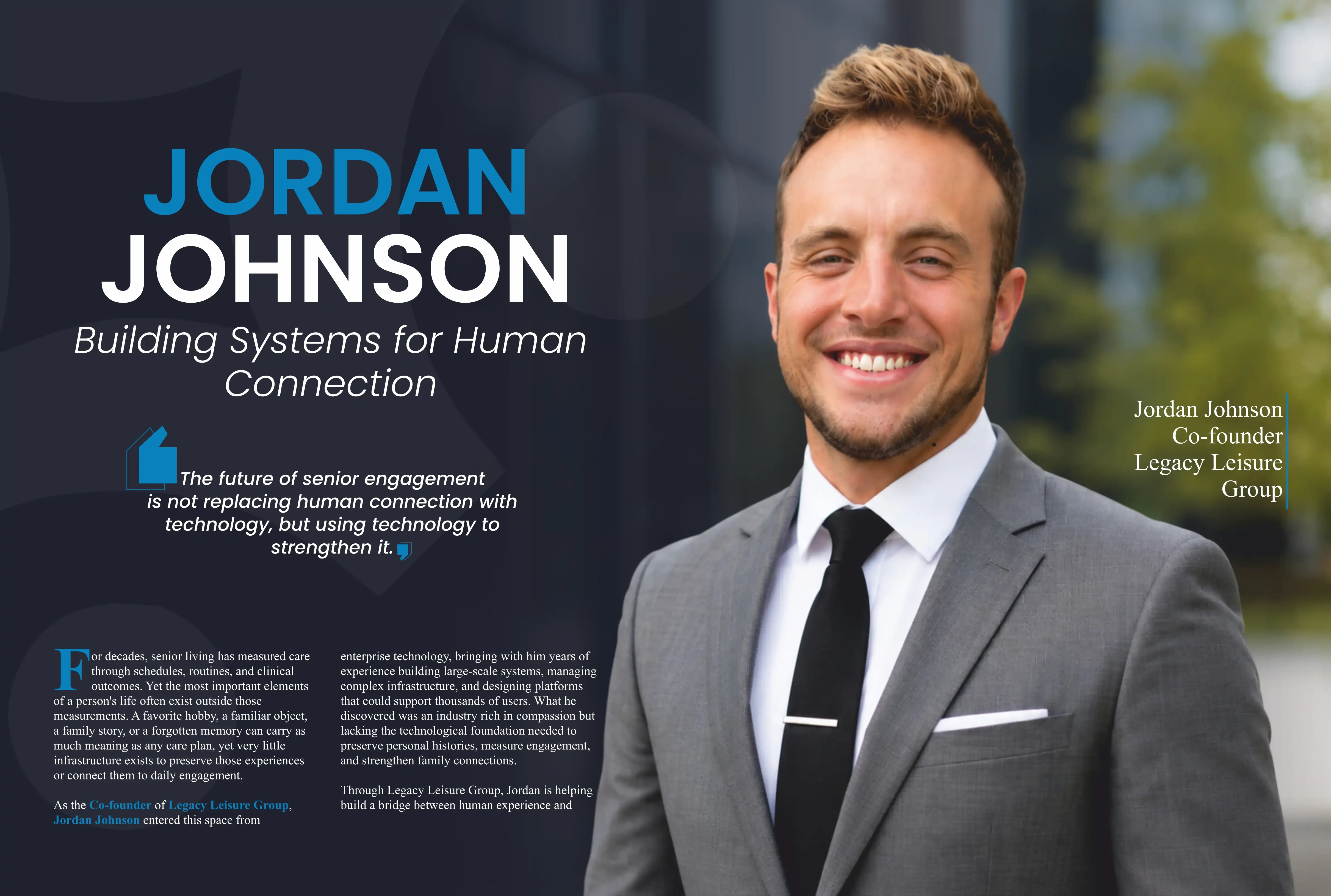
Jordan
Johnson: Building Systems for Human Connection
For decades, senior
living has measured care through schedules, routines, and clinical outcomes.
Yet the most important elements of a person's life often exist outside those
measurements. A favorite hobby, a familiar object, a family story, or a
forgotten memory can carry as much meaning as any care plan, yet very little
infrastructure exists to preserve those experiences or connect them to daily
engagement.
As the Co-founder
of Legacy Leisure Group, Jordan Johnson entered this space
from enterprise technology, bringing with him years of experience building
large-scale systems, managing complex infrastructure, and designing platforms
that could support thousands of users. What he discovered was an industry rich
in compassion but lacking the technological foundation needed to preserve
personal histories, measure engagement, and strengthen family connections.
Through
Legacy Leisure Group, Jordan is helping build a bridge between human experience
and intelligent systems, creating tools that transform memories into meaningful
engagement while ensuring that technology serves the people at the center of
every story.
Building the
Missing Framework
Jordan's journey into the
senior engagement and legacy preservation space did not begin in senior care.
It began in enterprise IT, where he spent nearly six years serving as a
Director of IT for a national distribution company. During that time, he architected
and maintained a custom ERP environment, managed technology operations across
numerous locations, and led large infrastructure initiatives.
When introduced to the
vision behind Legacy Leisure Group, Jordan approached it through the lens of
systems architecture. He recognized a significant gap that extended beyond
caregiving itself. While senior communities focused on preserving identity and connection,
very little technical infrastructure existed to support those goals.
Facilities relied on
activity calendars, paper documentation, and disconnected communication
systems, leaving valuable engagement information uncaptured. Jordan saw an
opportunity to build a structured framework capable of measuring, scaling, and
improving resident engagement. While his cofounder contributed years of
caregiving experience, Jordan focused on creating the technical foundation
necessary to support those insights. In his view, the industry lacked not only
products but also the architectural backbone required to preserve legacies and
track engagement at scale.
Technology That
Steps Aside
Jordan believes that
technology should remain invisible during meaningful human interactions. The
purpose of technology within Legacy Leisure Group is not to replace
relationships but to support them.
The Individualized
Engagement Kits were intentionally designed as physical and sensory experiences
featuring tangible materials, textures, and familiar objects. Meanwhile, the
digital systems, including family portals and administrative tools, operate quietly
in the background.
Jordan views technology
as a logistical and intelligence layer that ensures the right resources reach
the right residents at the right moments. These systems help staff access
information efficiently while allowing families to remain connected even when distance
prevents physical visits.
He compares effective
technology to strong infrastructure, where the best systems are often the ones
users barely notice. Databases, dashboards, and software should never become
the focus during moments of emotional connection. Instead, technology should
facilitate those experiences while allowing human interaction to remain at the
center.
Thinking Like an
Architect
Among his professional
experiences, Jordan considers infrastructure and systems architecture to be the
most valuable in building a new company.
While software
development teaches how to create individual features, infrastructure teaches
how to build systems capable of surviving real-world challenges. These include
inconsistent connectivity, varying levels of technical comfort among staff,
multiple locations, and the need to scale efficiently.
Years of managing
mission-critical systems taught Jordan to ask important questions before
development begins. He evaluates how systems fail, how they recover, who
assumes responsibility during outages, and how solutions perform across many
locations.
This architectural
mindset influenced the foundation of the Legacy Leisure Vault platform.
Decisions regarding data structures, authentication, hosting, and scalability
were made early to ensure the platform could support long-term growth. Jordan
believes that durable systems require planning far beyond the immediate needs
of a startup.
Privacy as a
Starting Point
Jordan approaches
innovation through the principle of privacy by design. In his view, security
and privacy decisions belong at the earliest stages of development rather than
being added after a product has already launched.
This philosophy shaped
the Legacy Leisure Vault platform from the beginning. The company intentionally
limited the types of information collected, focusing on engagement,
preferences, and personal histories rather than medical data. By establishing
these boundaries, Jordan believes the organization can provide meaningful value
while maintaining a lower risk profile.
Every new feature
undergoes evaluation through a privacy lens before its functionality is
considered. Questions surrounding access, encryption, data retention, and user
permissions are addressed before implementation.
Jordan believes that
taking additional time to establish secure foundations is preferable to
retrofitting protections later. For him, innovation and security are not
competing priorities but complementary parts of the same design process.
Lessons from
Enterprise Scale
Leading technology
initiatives that served more than 20,000 users taught Jordan one critical
lesson: build for scale from the very beginning.
Enterprise environments
leave little room for systems designed only for small groups of users.
Solutions that perform well for ten people often fail when introduced to
thousands. Having managed large technology deployments across multiple
locations, Jordan understands the challenges of rebuilding systems after growth
has already occurred.
This experience directly
influenced Legacy Leisure Group's development strategy. The Vault platform was
created with a four-phase roadmap from the outset, anticipating future
expansion rather than focusing solely on immediate needs.
Decisions regarding
hosting, authentication, and data architecture were made with long-term
scalability in mind. Jordan believes that understanding the difference between
a demonstration and a production system is essential, and he prefers investing
in a strong foundation before rapid growth places pressure on the platform.
Preserving Stories
Through the Vault
Jordan describes the
Legacy Leisure Vault as the technical heart of the organization. The platform
serves as a secure and structured environment where families can preserve
photographs, memories, stories, and personal histories.
His vision extends beyond
digital storage. Rather than functioning as a static archive, the Vault is
designed to actively influence resident engagement and care. Information shared
by families can guide activity selections, engagement kits, and daily interactions,
ensuring that personal histories remain connected to everyday experiences.
Jordan believes the
platform must balance security with flexibility. Families must feel confident
entrusting irreplaceable memories to the system while also benefiting from
meaningful connections between those memories and resident care.
Looking
ahead, he sees the Vault as a lasting foundation for Legacy Leisure Group. Once
families entrust their histories to the platform, the relationship extends
beyond a single care community, creating a long-term responsibility that Jordan
takes seriously as both a cofounder and the architect behind the technology.
Winning Trust
Through Small Victories
Jordan believes that
successful digital transformation begins with visible, early wins. Throughout
his career, he has observed that resistance to technology rarely stems from
opposition to improvement. Instead, it often arises from previous experiences with
disruptive implementations that promised transformation but delivered confusion
and frustration.
His approach focuses on
carefully sequencing adoption so that stakeholders experience immediate
benefits before being asked to embrace larger changes. Within Legacy Leisure
Group, this means introducing solutions gradually rather than expecting
facilities to overhaul their entire engagement programs at once.
Jordan prefers to begin
with a small number of Individualized Engagement Kits or a Family Portal
feature that addresses an existing communication challenge. Once staff members
witness a resident responding positively or families experience improved connection,
confidence in the broader system naturally develops. In his view, demonstrated
results create stronger support than presentations or promises.
Choosing Partners
for the Long Journey
When evaluating
technology investments, Jordan places greater value on stability and long-term
viability than on initial cost savings.
Experience in enterprise
IT taught him that the true cost of a vendor relationship often emerges years
after the initial purchase. Vendors that appear inexpensive may ultimately
create significant expenses through poor support, instability, acquisitions, or
discontinued products.
This philosophy has
influenced several foundational technology decisions within Legacy Leisure
Group. Jordan assesses technology partners much like he would evaluate a
long-term employee, considering factors such as track record, financial health,
quality of support, documentation, and commitment to solving specific problems.
For him, a vendor
relationship represents more than a contract or price negotiation. It is a
long-term dependency that can directly influence the success and stability of
an organization. As a result, Jordan prefers reliable partners capable of
providing consistent support over many years.
Knowledge
That Outlives Individuals
Mentorship plays a
central role in Jordan's leadership philosophy. He believes that knowledge
concentrated within a single individual creates both operational risks and
organizational bottlenecks.
His first principle is
comprehensive documentation. Decisions, architectural choices, and technical
reasoning should be recorded and accessible rather than remaining solely in the
minds of those who participated in a meeting. This approach ensures continuity
and enables teams to grow without becoming dependent on individual experts.
Jordan also believes that
meaningful mentorship occurs through collaboration on real challenges. Rather
than relying solely on instruction, he prefers to involve team members directly
in decision-making processes, allowing them to observe how tradeoffs are
evaluated and how mistakes are corrected.
In rapidly changing
technology environments, he believes the goal is not simply to teach current
tools but to develop individuals who can effectively solve unfamiliar problems
as technologies continue to evolve.
The
Intelligence Behind Tomorrow's Care
Of
all the emerging technologies, Jordan believes the one with the greatest
potential to change the landscape of senior living and memory care is
artificial intelligence-driven personalization.
Current
engagement programs frequently rely on static resident profiles that are
created once and utilized for long periods of time. “The future will be systems
that learn from engagement patterns and adapt recommendations accordingly,”
said Jordan.
In
memory care settings, predictive and personalized systems may help to identify
early signs of agitation, withdrawal, or behavioral changes before they reach a
serious level. These insights could help caregivers know when to introduce
sensory interventions or personalized activities.
“The
Legacy Leisure Vault and administrative systems are being built with this
future in mind,” says Jordan. Every engagement record and interaction captured
today lays a foundation that may allow for more sophisticated and personalized
care recommendations down the line.
Confronting the
Pressures of Senior Living
Jordan
believes that staffing shortages are the biggest problem for senior living
communities right now. Organizations are being asked to provide more
personalized experiences, often with limited staffing resources and high
turnover rates.
He
cites fragmentation across technology systems as a major hurdle, too. Many
communities utilize a variety of platforms for clinical documentation, family
communication, and activity programming, leading to inefficiencies and
hindering their ability to demonstrate measurable outcomes.
Jordan
believes that innovation needs to solve both problems at once. Technology
should alleviate administrative burden and provide meaningful engagement data
to support quality care.“With Legacy Leisure Group, we want to make things
easier for staff to plan, not to make work harder for them to do. “Successful
technology has to recognize the realities of senior living environments, where
teams have less time, fewer staff and increasing documentation demands,” Jordan
says.
A
Blueprint for Human-Centered Growth
Jordan’s
long-term aim for Legacy Leisure Group is deliberate national growth based on a
solid technical base. "Expansion should be on the roadmap we had laid out
already, not building something that is growing too fast for the underlying
infrastructure," he said.
He
wants the organization's technology systems to enable growth rather than impede
it. This requires ongoing investment in security, scalability and data
integrity to ensure families and residents have a consistent experience no
matter where they are.
Aside
from growth, Jordan would like to prove that person-centred care and
sophisticated technology can work well together at Legacy Leisure Group. The
caregiving vision remains central to the organization, but he sees his role as
ensuring the systems behind that vision are strong enough to support meaningful
growth.
Ultimately, Jordan wants the company to set a new standard for how technology can improve human connection in senior care, showing that thoughtful infrastructure can deepen relationships, not displace them.